
Commission preparing if landfill tract is sold to data center group
NAHUNTA — County commissioners gave no indication of which they may be leaning for a proposed amendment to the Land Use Ordinance to add data centers as a special exception under light industrial zoning.
The commission held a called hearing Tuesday, January 20 inside the courtroom at the Brantley County Courthouse which lasted nearly two hours and 40 minutes with the last hour open for the public to speak.
County Manager Joey Cason assured citizens the purpose of the hearing was “not to allow a data center in, but to allow the commissioners to determine whether or not they want to add data centers as a special exception to the land use ordinance.”
According to Cason, commissioners have received no formal proposals to erect a data center in Brantley County. However, he mentioned the Board of Commissioners had been informally approached by an unnamed individual expressing interest in building a Microsoft data center on the property where the controversial landfill was proposed by Brantley County Development Partners, LLC in 2016.
During a recent interview, Cason said, “At this date (Friday, January 9), our attorney has been in discussions with the landowners’ attorney and no formal offer has been made. Nothing’s on the table yet.”
The final decision on whether to proceed with this proposed amendment to the Land Use Ordinance will be made during the regular commissioner meeting Thursday, February 5.
Board members present at Tuesday’s public hearing were Chairman Skipper Harris and Commissioners Brian Hendrix, Andy Riggins, Randy Davison and Hal Herndon. County Manager Cason handled the meeting.
The evening opened with a 1 ½-hour informative video from the Association of County Commissioners of Georgia (ACCG).
The seven panel members on video were Mike Turner of Loudoun County, Va., Zane Grennell of Georgia Department of Community Affairs (DCA), Jason Shaw of Georgia Public Service Commission (PSC), Dr. Chris Manganeillo with Chattahoochee Riverkeeper, Attorney Bob Sherrier, Mike Lash from CBRE Group (dealing with real estate) and Dr. Steve Ledbetter of Paulding County, Ga.
They discussed how data centers have impacted communities in Virginia and Georgia and what the future of data centers might hold.
After the video concluded, Brantley Countians in attendance were allowed to take the stand. About 70 residents were in attendance with 19 speaking either for or against the proposed amendment to the Land Use Ordinance.
Five Brantley Countians approved of the proposed amendment so long as commissioners are transparent with the community about data center proceedings. The list included Ronald Ham, Phillip Benjamin, Gary Johns, John Hoffman and Steven Smith.
They also advocated to elect an in-county expert who would represent the desires of the community if a data center were ever to come to Brantley County. Those in favor said as long as commissioners could ensure the structure would “look half-decent” and not compromise the personal properties of residents, the amendment would have their support.

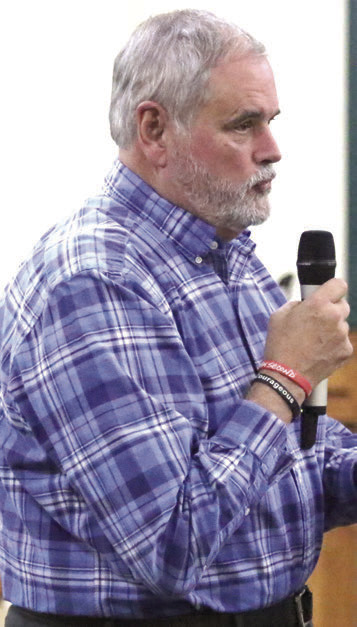
Fourteen citizens were not as optimistic about inviting a data center into the area.
Those speaking against were Robert Burke, Shannon Gregory (Satilla Riverkeeper), Lili Fulk, Madison Maassen, Kathy Wainright, Hampton Ammons, Scott Altman, John Laneve, Tonja Tomanek, Kimbo McMinn, Jonathan Lawhorne, Ronnie Douglas, James Flanders and Robert Wilson. Their consensus was there are more cons than pros to adding a major tech facility to Brantley County.
They said the county does not have the means to support the infrastructure it currently has, with Electric Membership Corporation (EMC) rates going up last year. Additionally, tax breaks on data centers wouldn’t result in more money being brought into the community, and minimal staffing wouldn’t bring many more jobs.
Health concerns included increased levels of nitrate in Brantley’s groundwater as a result of the data center’s wastewater dumping.
Though commissioners assured residents the center’s computers would use a “closed-loop” cooling system with recycled water from a manmade pond, citizens were not convinced all wastewater could be contained, and worried some may even be poured into the Satilla River.
They asked commissioners to consider the effect this could have on local wildlife and even food, as farmers would need to compete for clean water usage during droughts.
Those opposed claimed even if the center were to utilize an effective recirculation system, it would not save Brantley County from air pollutants caused by diesel exhaust from backup generators, which have been known to produce heart and lung disease – especially in those predisposed to respiratory issues.
Speakers with children told commissioners they were not willing to be guinea pigs for this relatively new technological advancement when their kids might have to answer for the decision someday. Others worried a physical presence of Artificial Intelligence (AI) in the area might be used to surveil residents.
They warned commissioners there would be no way of going back once a data center is invited into the area and encouraged waiting on further analysis from communities that have already been impacted.
When asked why commissioners couldn’t buy the land if Brantley County Development Partners were to sell and develop it into something beneficial for the community, they said they simply could not afford the estimated $14 million price tag.
Though speakers remained resistant to this change to the Land Use Ordinance, James Flanders said classifying it under “light industrial” would be inappropriate, and urged the commission to reclassify it as “heavy industrial” if they were to go through with the amendment February 5.
Since the surge of generative AI, data centers have been a more frequent topic of discussion amongst communities like Brantley County. These facilities are generally powered by small modular reactors, natural gas turbines, and diesel backup generators.
According to Dr. Manganeillo, a three-unit natural gas facility (like the one in McDonough, Ga.) can generate 2,530 megawatts of power and consume 7.5 million gallons of water per day. This is a staggering number compared to the daily 71,000 gallons of water used by 80-acre irrigated agricultural fields.
The benefit of a data center could include lowering real and personal property taxes. However, commissioners must decide if this is the right move for Brantley County.





Comments