
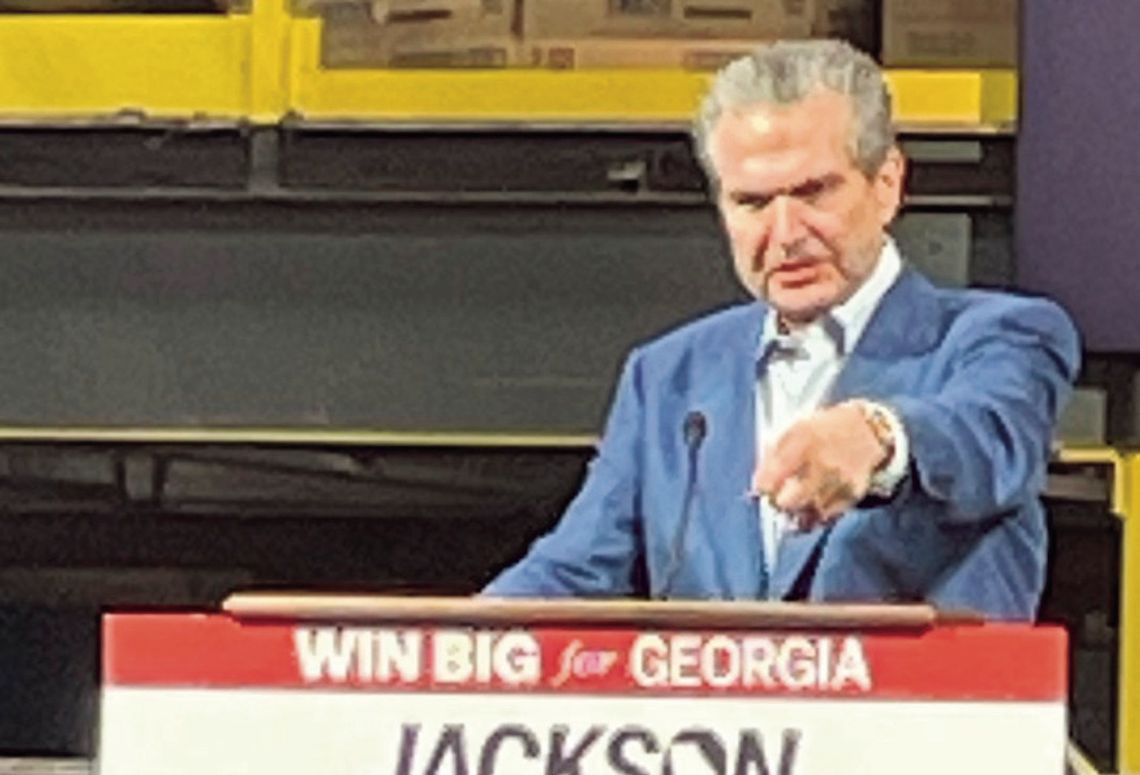
Rick Jackson, candidate for governor of Georgia, recently made a campaign stop at Stewart Distribution in Pierce County.
During his stump speech, Jackson recounted his difficult upbringing.
He outlined his path from foster care to building a multibillion- dollar healthcare company, and detailed plans focused on taxes, education, rural healthcare, public safety and economic development.
Jackson, who has never held elective office, told those in attendance he is running to apply his business experience to help the state’s most vulnerable residents and to represent all 11 million Georgians. “I don’t believe God sent Jesus here to save Republicans or Democrats ... He came here to save everybody,” said Jackson.
He described a childhood marked by instability. His father left when he was nine months old. His mother, a waitress with a sixth-grade education who struggled with alcohol, remarried multiple times. Jackson said he had seven stepfathers and attended seven elementary schools by age 12. The family lived in public housing. He credited a bus ministry from First Baptist Church of Atlanta with exposing him to more stable families and Christian faith. He was baptized twice as a child seeking assurance.
Around age 12, after a family crisis, an uncle took him to enter the foster care system. In his first foster home, Jackson witnessed a family pray together at dinner — an experience he said showed him “what normal is” and what he wanted for his own life. Jackson later lived at a Methodist children’s home and graduated from Greater Atlanta Christian School. He worked multiple jobs, including selling women’s shoes and loading UPS trucks, but left college after one quarter because he could not afford it. At 19, he married and moved to a trailer park in Lilburn.
At 20, rejected for a recruiting job because he lacked a four-year degree, Jackson offered to work on commission only. He was hired, and a year later, at 21, he bought the firm. Jackson later focused on recruiting physicians to rural areas across the Southeast, which led him into healthcare. After earlier entrepreneurial ups and downs, the company he rebuilt starting in 2000 grew from $30 million in revenue to $3 billion last year, serving 25 million patients annually.
A spiritual turning point came in 2007 at the Halftime Institute in Dallas, Texas. Jackson said he concluded the wealth he had accumulated was “God’s money” of which he was a steward. He drew a personal “finish line” on lifestyle spending and committed to give away 100 percent of anything above it. He described his purpose since 2008 as achieving “kingdom impact” by helping “the least of these.” Through nonprofits, his efforts have included a foster-care organization that has served about 3,000 children with more than 400 adoptions, an orphanage in China that has fully funded care for over 100 children, and support for a church in Iran, among other initiatives.
Jackson said this focus led him to engage on foster care policy. After testifying before a state Senate committee under then-Governor Nathan Deal — where a long-time senator noted he had never heard the issue raised — he decided to devote his influence to the cause. Jackson described writing and advancing the Fostering Success legislation, which passed with unanimous bipartisan support and took effect in 2023. Beyond free tuition for youth aging out of foster care, the measure provides support for food, rent, transportation, computers, and other needs, supplemented by a nonprofit that supplies Christian life coaches. He said about 800 young people are now in the program and “thriving,” gaining “hope” for the first time. He cited grim statistics on pregnancy and arrests among those who age out without support, noting that jails hold many such young people.
Looking ahead, Jackson committed to cutting the state income tax by 50 percent in his first term. On property taxes, he proposed freezing valuations so taxes would not rise solely because of home appreciation, while requiring counties to adopt more disciplined budgeting processes similar to those used by the state under Governor Brian Kemp.
On education, Jackson highlighted literacy as a priority. Noting that two-thirds of Georgia third-graders are not reading proficiently, he praised the state’s recent literacy bill — the first in decades — and said he would lead from the front. Jackson pointed to Mississippi’s gains (the “Mississippi Miracle”), which he attributed to phonics instruction, teacher training, and a policy preventing promotion from third grade without the ability to read. He recalled seeing education, not race or wealth, as the key dividing line during his time in the projects.
In healthcare, drawing on his industry experience, Jackson said he would expand rural access by supporting the creation of 10 additional hospitals and recruiting workforce. Jackson proposed what he called the largest state-level health IT system in the country so residents could access and share their medical records, know costs before treatment, and avoid repeatedly providing the same information. He said he would prevent insurance companies from denying coverage ordered by doctors purely for financial reasons and would negotiate on behalf of the state for lower drug and other costs.
Jackson identified keeping people safe as a governor’s top responsibility. He said he backs law enforcement “110 percent” because prosecuting crimes prevents further victimization, and he criticized his opponent for prioritizing criminals over victims and police. “When you take up for criminals over victims and police, you’re disqualified,” he said.
On the economy, Jackson said Georgia has done well attracting large industries and he would continue and improve that effort by dealing directly with CEOs. His larger focus, however, would be bringing capital into existing Georgia businesses and startups so the state becomes the top place for entrepreneurs. Jackson highlighted agriculture — described as the state’s largest “business,” with over $100 billion in annual activity — as the priority. He proposed cost-effective capital for farmers, rebuilding packaging and cold-storage infrastructure exposed as weak during COVID-19. Jackson wants to keep more value-added processing instate rather than sending products out for finishing. He also wants high schools and technical colleges to promote high-paying trade and agricultural careers as alternatives or complements to four-year degrees, calling the Technical College System of Georgia one of the state’s best-kept secrets. Georgia Tech’s AI work, he said, should be leveraged so talent does not have to leave for Silicon Valley capital.
Jackson closed by stressing he does not need a political title, that his company’s top value is “others first,” and his purpose remains helping people leave poverty through jobs and training. He expressed concern rural voters may take the race for granted and urged turnout, noting Georgia is no longer reliably red and outside influences could matter. He asked for votes while saying he would continue his work regardless of the outcome.








Comments