
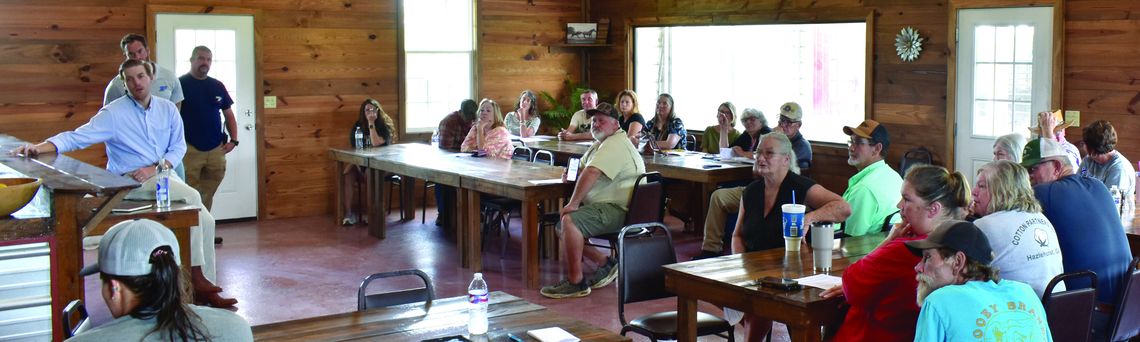
What was originally meant to be a series of informal lunches for Ian Evans, hired to represent Grenergy and their proposed Battery Energy Storage System (BESS) in Patterson, became a larger, more community oriented question and answer session last Friday.
The meeting began with a prayer and quickly got down to business. Evans found himself once more fielding questions from Pierce residents, only this time it was from over 30 Patterson residents and Pierce Industrial Development and Building Authority Executive Director Blake James and Pierce Fire Chief Chris Todd.
Evans seemed pleased by the crowd and said so. “What would usually be just a lunch turned into a large gathering, so I’m glad so many people are interested and turned out.”
If Evans was nervous or concerned that many, if not all of those present were opposed to the proposed BESS facility, he did not show it outwardly. He said more than once he did not expect to change any hearts and minds at the gathering. His stated purpose was solely to provide information and dispel inaccuracies about the BESS project.
Repeating a recent point made by Ellen Smith, who attended the Tax Assessor Board meeting in his place, Evans clarified Grenergy would not be buying electricity and selling it back to any utility companies.
“That is in unregulated energy markets like Texas,” said Evans. “Georgia is a regulated market.”
Essentially, Grenergy would lease the proposed facility to a utility provider, allowing them to capture unused energy that would otherwise be lost through “line loss” and put power back into the grid when demand is higher.
Confronted about the lack of jobs offered by the project, Evans reaffirmed previous statement by James of the Pierce IDBA saying the project was never billed as a job creator.
“We have been very transparent with the county. This is not a job creator. This is a property tax generator.” The proposed site would be a remotely monitored, unmanned facility.
Trey DeLoach asked a question which, in one form or another, seemed to be on the minds of many present.
Grenergy
“Why do people come here with these? Why don’t you go to the industrial parks and the cities?”
Evans tried to explain some of the criteria used to select potential sites for BESS facilities, including proximity to substations, available excess power and other factors, but was met with skepticism, especially by those there who felt the tax breaks being offered to Grenergy were too generous.
The question was called out again not too much later, “Why is right here the ideal location for this project?”
“Because it don’t serve us! It serves Florida!” called out Edward King, also an attendee at the recent tax assessor meeting.
James waded in to answer some of the questions about the tax breaks. “Tax abatement is not a 100 percent abatement. They will pay roughly 9 million over 15 years, but every IDA offers abatements to attract large capital investment. We have to in order to stay competitive.”
Asked if that money goes specifically to Pierce County, James replied it did, but Gene Paul Paschal seemed unconvinced. “We’ll never see it,” said Paschal.
James made what is becoming a familiar refrain, caught as he is between trying to encourage taxable investments in the county and locals who are already unhappy with the millage rate. “I’m not with the board of commissioners. I don’t set the millage rate and I don’t assess the property values,” said James. “My job is to try to bring investments and jobs to Pierce. In a best case it’s both, but with this it’s tax revenue.”
“Where we need to put it then is by the county commissioners’ office,” said Paschal.
James went on to outline Grenergy’s promised donations to the county fire department and scholarship monies for Pierce County High School graduates, which are good incentives for some, but others in the crowd were homeschoolers or elderly residents already questioning why they should have to help fund schools to begin with.
Others like Malcolm Boyette, one of the meeting’s organizers, were curious about the noise level of the proposed site. Evans said the county already had a noise ordinance in place to which Grenergy would conform. Several were concerned about the possible effect of noise or anything else that might affect animals nearby. Some in the gathering were ranchers with horses or hunters concerned about disturbing local deer.
Evans told them the county’s noise ordinance was actually more strict than federal guidelines, but DeLoach was unconvinced, citing something about the batteries themselves. “I can tell you, a little lithium ion battery on a camera affects them [deer],” said Deloach. “If animals don’t want to be around it, we don’t want to be around it either.”
Safety and the potential for “thermal runaway” which can cause BESS batteries to ignite was another topic much discussed. Pierce County Fire Chief Chris Todd said he had already attended trainings regarding lithium ion battery fires. Previously realizing such things would be an issue in the future with the rise of electric vehicles, Todd did not seem overly concerned about his team’s ability to handle such a situation if one did arise.
Asked by one member of the crowd if he was aware that litium ion batteries cam burn in excess of 3000 degrees, Todd replied, “Did you know on a regular house fire, where we go in to save people, already burns at 2000 degrees?”
“I have lived here for 41 year. I’m 41 years old. My parents farmed before they logged and my daddy logged until he died,” Todd said by way of establishing his local credentials to those that did not know him. He cited the lithium ion batters people already accept around them each day in phones, ipads and even electric toothbrushes.
Challenged by one audience member that if thermal runaway does happen, it would get down into the ground and cause potential contamination, Todd said, “No it won’t. It’s in a metal box.” Evans also made a point to clarify the ConEx containers the batteries are stored in are air and water tight units made to keep any gases released by thermal runaway well contained.
Nikki Paschal, wife of Gene, remained unconvinced, holding up search results on her phone which said flammable hydrogen and hydrocarbon vapors from thermal runaway could accumulate in sealed enclosures and even explode. “I’m a local business owner, but we’ll sell and move before it comes to that,” said Paschal. “We care about each other around here. Pierce County is never going to go for something like this.”
Others seemed, if not won over or convinced, then at least partially satisfied some of their questions had been answered. Asked how many of his concerns had been addressed at the meeting, Malcom Boyette said, “About 70 percent. I understand what they’re doing with the taxes. If you’re going to bring them in, you got to give them something. My main concern was fires.”
Still others present wanted to know what was the next step in the process. “We are not even at the stage yet where we go and get a use permit from the county,” said Evans. It seems there is still a long way to go before Patterson’s potential BESS site becomes a reality and odds are good the local residents will have plenty to say about it along the way.







Comments