
Blackshear City Council debates what to do about trash cans crowding local roadsides
The August 4 work session of Blackshear’s City Council included some civil but spirited debate about proposed solutions to trash cans crowding the rights-of-way along city streets.
When most of us learned to drive, we were told to always check your mirrors. Ordinarily, this was to make sure you didn’t run over anyone or anything while driving in reverse. In some parts of Blackshear, the phrase is more of a warning to watch out for trash cans along the side of the road.
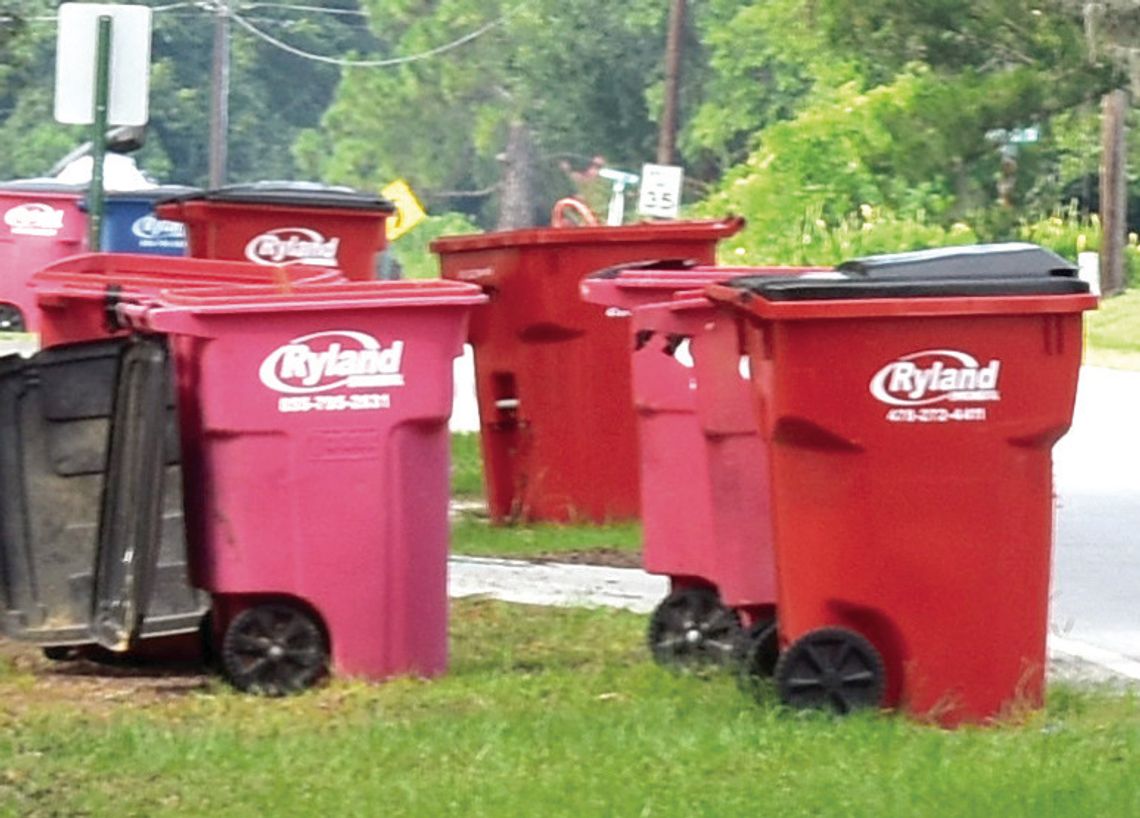
Mayor Keith Brooks says a frequent complaint brought to him while campaigning for re-election last year was the presence of the familiar red Republic trash cans crowding one or both sides of the road, which forces traffic closer together, causing one party to slow or stop so the other can pass or resulted in a vehicle’s side mirror smashing into the trash can. Seeking to fulfill a campaign promise, Brooks made his proposal, then opened the floor for discussion by the city council and department heads present at the meeting.
Brooks’s proposed solution was a resolution requiring residents to pull their trash cans back from the right of way beside the road and onto their own property within a 24 hour window following the emptying of the can. What followed was a lively discussion of a variety of opinions, something not often seen among the typically united and unanimous city council. Some agreed, some disagreed and others had questions.
“I’m against it,” said council member Jerry Boatright (District 2). “I’m not in a HOA (home owners association). In my opinion this is a government overreach.” Council member Charles Broady (District 4) says, “I have never heard of this being a problem in my district. The only ones I see on the road are after the trash man dumps it.”
Bethany Strickland of Better Hometown Blackshear and the Downtown Development Authority asked, “What would be the repercussions? If I go out of town on a Thursday and don’t come back until Sunday I don't want to be in trouble.”
As the discussion developed, it became clear, while other streets and areas were mentioned, much of the issue centers around Church Street, especially the stretch approaching the Blackshear city limits, where recent construction has created a high density of residences, most with a trashcan not far from the road.
Council member Mitch Hall (District 3) was quite familiar with the area in question. “My wife hit one (trash can) right where you are talking about,” said Hall.
A flurry of ideas, complications, questions and alternate proposals swirled about the council chamber. Some felt the entire city shouldn’t be penalized when the problem was only specific to certain streets or neighborhoods. Some proposed figuring out a way to make the new policy area specific. Others wanted to know what the consequences would be if there was an ordinance put in place. Still others thought a public notice advising citizens to move their cans back from the edge of the road once empty was more appropriate than a resolution compelling them to do so.
“The problem is if we do a public notice and there is no teeth to it,” Brooks said and shrugged, letting the statement speak for itself.
Council member Corey Lesseig (District 5), who resides near Church Street and has seen the area in question, said, “I think what we’re getting into is it a nuisance or a safety factor?” Lesseig also noted that trash cans have been seen close to or even in the road along College Avenue when windy conditions push the empty canisters into the right of way.
Brooks finished with “We can revisit this and see if something can be done in certain areas.”
The Times reached out to Ryland Environmental about the issue and spoke with Richard Lee, the local Division Manager, seeking clarification on if there existed any guidance from Ryland to consumers about the placement of the trash cans.
“You just have to use common sense in some cases,” said Lee. “Not every home is the same. In cases of properties with a steep ditch or embankment the can might not be able to be kept further back from the road. We do give our drivers guidance about when they set the can back down to ensure it is not in the road.”
Lee said he was aware of the area under discussion by the council. He also said there have not been any recent reports of anyone striking a can with their vehicle nor losing a side mirror, but acknowledged such things can happen. Lee indicated that if there is an issue with trash cans within the city he would be glad to make himself available to the city to discuss it, but said the council had not reached out to him in this instance.
Given the amount of discussion surrounding the issue and without a plan in place, the matter will not be voted upon at the city council’s next regular session, scheduled for Tuesday, August 11. The current edition of The Times went to press prior to the regular meeting. Any changes or updates will be reported upon in future editions of The Times.


Comments