
Edgerton hit with 3 counts in filing
WAYCROSS — A lawsuit against a Brantley County Sheriff’s Office deputy has been filed with the United States District Court Southern District of Georgia Waycross Division.
Attorney Roland Mumford, with law offices in Savannah and Richmond Hill, filed the 25-page, three-count lawsuit Saturday, July 11, 2026 against Deputy Christopher Edgerton in his individual capacity.
The lawsuit is asking for compensatory damages with pre and post judgment interest to Plaintiff due to Defendant(s)’ unlawful actions in an amount not less than $300,000.00 or to be determined; Punitive damages to Plaintiff in an amount to be determined; Award to Plaintiff the costs and disbursements of this action, including reasonable attorneys’ fees, costs, and expenses; Attorney’s fees pursuant to Fed. R. Civ. P. 54, 42 U.S.C. § 1988, and/or any other applicable rule or law.
Mumford is representing James “J.T.” Flanders, who was escorted out of the meeting, handcuffed (his request) and placed inside the back seat of a Brantley County Sheriff’s Office vehicle outside the Commission office following a Thursday, February 26 dispute near the end of committee meeting.
According to County Manger Joey Cason’s February 27 interview with The Brantley Beacon, Flanders had been asked to leave the meeting by law enforcement, came back, was asked to leave again, said he didn’t have to leave, and the officer put him in his vehicle.
“If he (Flanders) hadn’t returned, nothing would have happened,” said Cason. “The sheriff (Len Davis) was called. He came in, listened to the whole situation, and he let the individual go.”
The charges read:
• Count 1: First Ammendment Retaliation in Violation of the First and Fourth Amendment (42 U.S.C. § 1983) The lawsuit states the First Amendment protects individuals’ rights to express speech, including criticism and objections toward government entities, elected officials, and/or police conduct about matters of public controversy in a constitutionally protected forum.
It is clearly established that a person has the right to be free from retaliation for exercising their First Amendment freedoms.
Retaliatory conduct adversely affects protected speech if the conduct “would likely deter a person of ordinary firmness from the exercise of First Amendment rights.” Bennett, 423 F.3d at 1254.
Plaintiff, as a person of ordinary firmness, would be deterred from exercising their first amendment rights after being falsely detained, subject to seizure, and/or arrested without reasonable suspicion, arguable probable cause, probable cause, and/or such other legal basis.
Plaintiff’s detention, seizure, and/or arrest was retaliatory. Defendant detained, seized, and/or falsely arrested Plaintiff without reasonable suspicion, arguable probable cause, probable cause, or such other legal basis as retaliation for the exercise of such free speech and this satisfies the third element of a causation.
Defendant retaliated against Plaintiff, by detaining, seizing, and/or arresting him for exercising protected speech. Defendant was acting under the color of State law while searching, detaining, seizing, and arresting Plaintiff and this was in reckless disregard of Plaintiff’s rights.
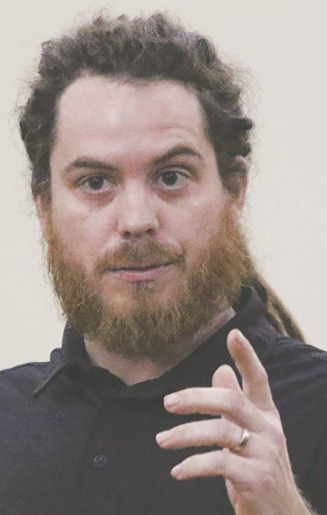
James Flanders FILE PHOTO
This detention, seizure, and/or arrest of Plaintiff deprived him of his liberty.
This was a violation of Plaintiff’s First and Fourth Amendment rights.
• Count 2: Unlawful Search and Detention/Seizure, Violation of Fourth Amendment (42 U.S.C. § 1983) Plaintiff has a constitutional right to be free from unlawful searches, excessive force, and detentions/seizures without reasonable suspicion. Detention and seizures for the purpose of this Complaint shall have the same meaning.
The alleged acts referenced above by Defendant was conducted without reasonable suspicion, search warrant, or legal justification and such acts are unlawful and a violation of each and every Plaintiff’s Fourth Amendment Rights.
As a general principle, a person is seized under the Fourth Amendment when there has been “a meaningful interference with his freedom of movement.”
Although brief encounters between police and citizens require no objective justification, United States v. Weaver, 282 F.3d 302, 309 (4th Cir. 2002), it is clearly established that an investigatory detention and/or seizure of a citizen by an officer must be supported by reasonable articulable suspicion that the individual is engaged in criminal activity. Terry v. Ohio, 392 U.S. at 21, 88 S.Ct. 1868 (1968).
An individual is “seized” within the meaning of the Fourth Amendment when either he is told that he is not free to leave, or when, “in view of all of the circumstances surrounding the incident, a reasonable person would have believed that he was not free to leave.” United States v. Gray, 883 F.2d 320, 322 (4th Cir. 1989). A detention shall have the same meaning and operation of law.
It is clearly established that a detention and/or seizure without articulable reasonable suspicion violates the Fourth Amendment. Terry, 392 U.S. at 21, 88 S. Ct. 1868.
Defendant unlawfully detained and/or conducted a seizure of Plaintiff by physically assaulting, battering, and restraining him without a warrant, probable cause, evidence of a crime being committing, or reasonable suspicion of criminal activity.
• Count 3 is Unlawful/False Arrest Violation of Fourth Amendment (42 U.S.C. § 1983) Plaintiff has a constitutional right to be free from unlawful searches, excessive force, seizures, and arrest without probable cause. The alleged acts referenced above by Defendant was conducted without reasonable suspicion, search warrant, arrest warrant, arguable probable cause, probable cause, and/or legal justification and such acts are unlawful and a violation of each and every Plaintiff’s Fourth Amendment Rights.
As a general principle, a person is seized under the Fourth Amendment when there has been “a meaningful interference with his freedom of movement.”
It is clearly established that an arrest made without probable cause violates the Fourth Amendment. See Von Stein v. Brescher, 904 F.2d 572, 579 (11th Cir. 1990).
Defendant unlawfully arrested Plaintiff by physically assaulting, battering, and restraining him without a warrant, arguable probable cause, probable cause, evidence of a crime being committing, or reasonable suspicion of criminal activity.
The lawsuit also seeks restitution for Injuries and Damages to include, but are not limited to: ∞ Physical pain and mental/emotional distress referenced herein both past and future; ∞ Inability to enjoy the normal pleasures of life both past and future;
∞ Such other emotional harm including fright, shame, and mortification from the indignity and disgrace, consequent upon such an illegal detention, assault, and invasion of privacy;.
∞ Nominal damages; ∞ Such other damages permitted by federal and/or state law; ∞ Punitive damages against Defendant based upon his intentional and reckless conduct.
∞ Punitive damages against Defendant based upon his intentional and reckless conduct.
The committee gathered February 26 included commissioners Randy Davison and Andy Riggins, a member of the Planning Commission, a Brantley County Chamber representative, the Development Authority and Satilla Riverkeeper. Loretta Hylton was presenting a draft of an ordinance concerning data centers.
The purpose of the February 26 meeting, according to Cason, was a discussion for committee members in developing a Land Use Ordinance for the possibility of a data center.
“The meeting was to gather everyone’s thoughts on the draft,” Cason said. “It was not a formal meeting. I gave the guideline no one could comment until the end of the reading and let the committee members have the meeting. I have no say in that committee. Unfortunately, that didn’t happen.”







Comments