
A year long evaluation leads to Nebraska
HOOVER, AL — It’s the call every college umpire wants to receive—selection to the College World Series in Omaha, NE.
Pierce County alum and former Minor League umpire Jason Bradley got the call Monday, May 18 while en route to Hoover, AL, to work the Southeastern Conference (SEC) tournament.
“They (NCAA) selected the top 10 college umpires for this year,” Bradley said Thursday, May 21 while enjoying a day off from the tournament. “I think there’s 1,600 umpires across the country calling college baseball.”
Bradley was scheduled to work the last three days (Friday, May 22-Sunday, May 24) of the SEC tournament. He’s been chosen to work in the Regionals (May 29-June 1) and Super Regionals (June 5-June 7) before heading to Omaha and the College World Series June 12 through June 22.
“It’s a big honor,” said Bradley of his selection. “All the work I’ve put in and to finally get this opportunity is humbling. This is my 15th year working college baseball, and my ninth year working the SEC tournament.
“This has been one of my goals, and I finally achieved it. It’s been a lot of hard work to get here...it’s very competitive. There’s a lot of good umpires across the country. I’m fortunate enough just to be one of those chosen this year for Omaha.”
Bradley, who was scheduled to work the SEC championship game Sunday (May 24), will serve as a crew chief at the regional tournament before moving on to the Super Regional.
He explained the selection process to receive an invite to the College World Series. Umpires must have at least three regionals and three super regionals on their resume to be eligible for selection.
“I’ve had seven regionals and three super regionals entering this year,” Bradley said. “I’ve been on the short list for the last few years...I was able to break through this year. You get evaluated throughout the year with strike zone initiative, basically it’s a big deal now.”
The SEC initiated the use of the ABS (Automated Balls and Strikes) system used the past couple of seasons in the minor leagues and implemented this year by MLB for the tournament.
“The ABS was just introduced here for the first time as an experiment at the SEC tournament,” said Bradley. “They (evaluators) look through all your data for the year for strike zones, and then they evaluate you as a person and how you handle situations...it’s a year-long evaluation.

Bradley
“I was evaluated a lot. I’ve never been seen this many times. It was like 10-15 times this season. They were really looking at trying to make sure they made the right choices. So, they send out regional supervisors to watch games. They also watch games on TV to evaluate.”
Bradley added the ABS is good, but it puts added pressure on the umpires. He was the first umpire to be challenged in the opening game of the SEC tournament.
“The good thing is I got it right,” he said. “A batter is having a good year getting three hits every 10 at bats. I was 3for-10 when challenged in that first game. “This ABS system has really put a different wrench in our (umpires) gear. We’re just trying to beat a computer. MLB umpires had all of spring training to get used to the system—we had one day. It’s an added pressure.
“There are big league umpires who are having mental health issues because of having balls and strikes overturned. Getting flipped takes a lot of mental fortitude. We’re all adjusting. ABS is good, we like it, we understand it, so we have to adapt.”
The cost to have the same system in every stadium is roughly $150,000 per.
“The NCAA may adopt this next year,” he said, “but, it’s very expensive. We’ve (umpires) heard the SEC is going to try to put it in next season.”
Bradley also feels the best baseball is played on the east coast.
“I work in the SEC and ACC and the level of intensity in both of those leagues are like none other,” said Bradley. “Mississippi State draws 10,000 fans, Arkansas will have 8-10,000 and LSU 8,000— it’s just a lot of pressure at those places.
“Fans are fanatic everywhere you go. They’re going to scream...they purchased a ticket so they have that right.”
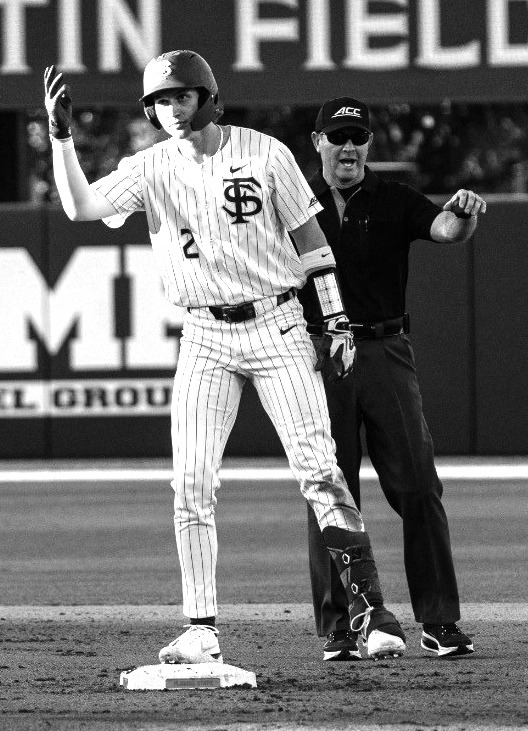
Umpire Jason Bradley stands behind a Florida State player on the field in Tallahassee.



Comments