
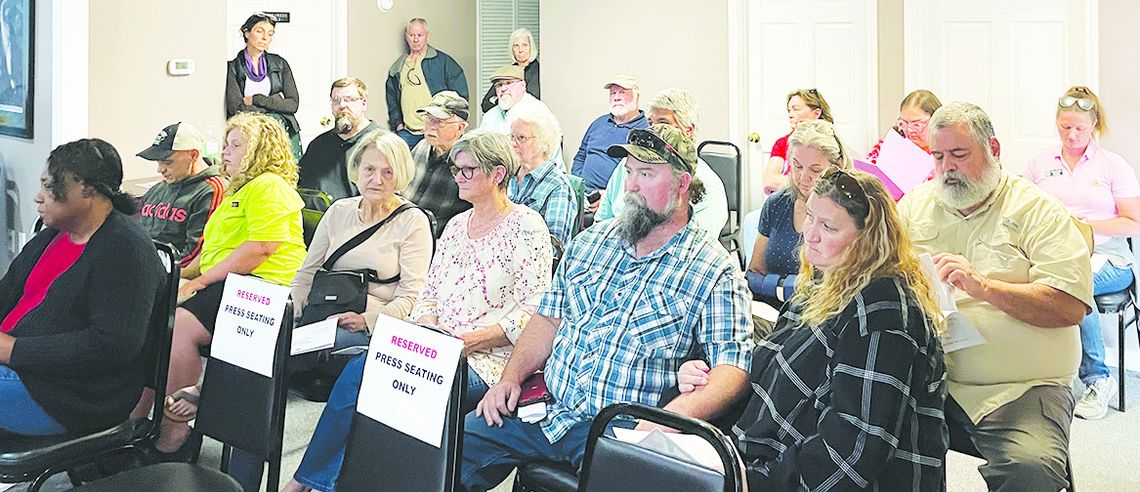
NAHUNTA — Data centers are still the talk of the town, judging by public participation during the Brantley County Commission’s work session Tuesday night.
Fourteen Brantley County residents expressed their opposition to the proposal to amend the Land Use Ordinance to allow data centers under “light industrial.”
These residents included Shannon Denbow, Nicholas Dunegan, James Duncan, Tonja Tomanek, Kathy Wainwright, Robert Wilson, Ruby Thomas, Shannon Gregory, Mathew McGrath, David Hall, Anna Babcock, Michaela Sanders, Debbie Robinson and Kat Montgomery.
Lilly Fulk, Raymond Willis and Patricia Goodwine were also on the agenda to speak, but were not present at the Tues-day, April 7 session.
Denbow argued commissioners should not “do any favors” by labelling data centers “under ‘light industrial’ when it’s truly ‘heavy industrial.’” Dunegan talked about the many dangerous chemicals used to power these centers.
“We have biocide, and those prevent mold and algae,” he said. “We have chlorine dioxide, bromine - corrosive inhibitors, they prevent rust. Phosphates, anti-scaling, prevent mineral buildup.
“Some secondary contaminants you’ll find in this water include copper, zinc, chromium, lead, cadmium, PFSAs. These are forever. They’ve done tests, studies. They don’t get out of your skin until they aerate it like how we all do with our water down here in our well system.”
PFSAs are used in firefighting foams, industrial applications, and consumer goods.
Duncan presented commissioners with an email itinerary from the Environmental Protection Agency (EPA) showing a landfill is still scheduled to be built on the property for which the controversial amendment to the Land Use Ordinance was proposed.
“In this particular message, they tell you everything the landfill is supposed to do from January 21, 2026,” said Duncan. “So far, they have followed this itinerary to a T. So I’m having difficulty understanding … where are you getting the information that this (landfill) isn’t coming?
“They’ve even got an opening date of 2028, so until I hear otherwise, I’m going to go with the information I have. I believe that if you’re going to hand out information, you need to be backing it up with data or some kind of proof.”
Tomanek expressed concern about the reliability of those establishing data centers in rural communities like Brantley.
“There’s no way we can have an ordinance that is going to be bulletproof,” she said. “
We’re already seeing the patterns from the ones that are already up and running. They made the promises … the new fire trucks and the roads and all the shiny things, but now they have no water. The utility bills are through the roof. They can’t pay. This is what evil does. Good doesn’t do that.”
Wainwright presented a timeline of all data centerrelated events in Brantley County since conversations surrounding the issue started in December 2025. She claimed commissioners were allowing too many decisions to be made behind-the-scenes without public input.
“Mr. Chairman (Skipper Harris), does this board support transparent or closed-door policies?,” asked Wainwright. “Will the board consider opening some doors and providing the public with another transparency commitment on data centers and give us an update on where the board stands concerning these things in Brantley County?”
Wilson believes the county should purchase the land to develop it into another industrial park, while Thomas thinks commissioners should keep their sights on the Lord and the citizens’ concerns.
Gregory shared her expertise as Satilla Riverkeeper and founding member of Brantley’s data center ordinance committee, reminding commissioners Brantley County sits on “environmentally sensitive areas” such as the Satilla wetlands and the Floridian Aquifer.
McGrath brought a “care package” for the Board of Commissioners, which included reading glasses and Q-tips, “because it seems like y’all don’t listen to anything we have to say.”
Hall, a candidate for the Georgia House of Representatives, said data centers require massive amounts of energy, which is paid for out of residents’ pockets.
“Senate Bill 34 would have made it clear that if a data center drives up the cost of electricity, the data center pays for it, not you,” said Hall. “But instead, that bill didn’t pass. We got a weaker version that moved forward, House Bill 1063. This one says utilities should protect customers, but it relies on promises and contracts and has no harm rules. We all know what ‘should’ means, does not mean ‘will.’
“Georgia Power actively opposed stronger protections like Senate Bill 34, so let me ask you, if the company is fighting against a law that says they can’t pass costs on to you, what do you think they plan to do?” Hall said.
He continued, “The freeze on Georgia Power rates ends in 2028. … Roughly 15 years ago, Georgia Power made a deal to help fund nuclear facilities. How’d they do that? The majority of the funding came from us, the people that had Georgia Power.
“And I know that for fact, because I saw it on my bill, and I called them and I said, ‘Hey, what is this thing I’m paying for?’ They told me that’s what it was. I told them I didn’t agree to that. They told me basically that if I had Georgia Power, I’ve agreed to it.”
“So whenever they tell us, ‘Don’t worry, it’ll be handled responsibly.’ Why would we trust them? Once our land is changed and those lines get laid and all that jazzy stuff gets done, we don’t get to take anything back. It’s over. So whatever our committee here decides to do, you have one chance to get it right.”
Babcock and Sanders both moved to Brantley County to get away from major land development in cities like Savannah. They were disappointed to hear about the county’s plans to potentially introduce a data center in the future, and begged commissioners for transparency and to consider the taxpayers in their decisions.
Robinson called attention to the impacted health of Brantley County’s children and elderly if a data center were to enter, insisting there is a better use for county land.
Montgomery, the south coast advocate for the conservation nonprofit 100 Miles, spoke last.
“At the February work session, I asked (County Manager) Mr. (Joey) Cason if 100 Miles could be involved in the ordinance writing,” said Montgomery. “He told me that he would be glad to include us on the committee, but that’s the last thing that I heard from (him).
“Even though I emailed, reached out and called, the draft was created, we were not involved in that process at all.”
She handed 100 Miles’ sample ordinance to commissioners for their review. Montgomery congratulated the ordinance committee on drafting a well-thoughtout ordinance, but mentioned some parts may need revising.
“How do you define a closed-loop system?,” asked Montgomery. “We would say that you would need to revisit that, because as it’s written in your ordinance, it only mentions the air. But what that would need to specify is about water usage. What would also be good to add is some kind of plan regarding what will happen in a natural disaster or a hurricane.”
Commissioners acknowledged each citizen’s concerns and accepted every informational handout for review, but provided little information about their formal stance on the matter during the Tuesday work session







Comments