
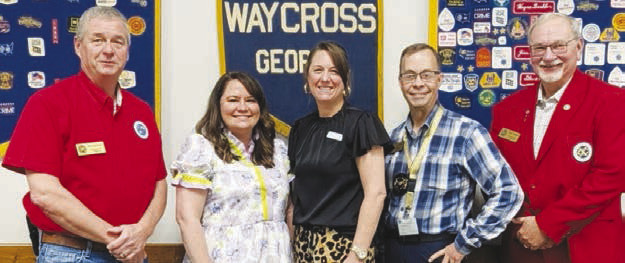
WAYCROSS — The Exchange Club of Waycross welcomed two guests speakers Thursday, whose message resonated deeply with members and guests alike.
Laura Pearson, LPC (Licensed Professional Counselor), and Dory Chapman, CMCLC (Certified Master Christian Life Coach), Operations Director and Life Coach from the Nahunta location of Centered for Life, shared an uplifting and insightful presentation on the organization’s mission to bring healing, restoration and renewed purpose to individuals and families across Southeast Georgia.
Centered for Life, a non-profit Christian counseling ministry founded in 2010 by Steve and Debby Temmer, has spent more than 15 years walking alongside people during some of the most difficult seasons of their lives.
Their mission is rooted in a simple, but profound belief that true healing comes from caring for the whole person — body, soul, mind and spirit.
Pearson and Chapman explained the organization provides a wide range of services, including clinical counseling, life coaching, pastoral counseling, and group therapy. Their team serves children, adolescents, adults, couples, and families, offering support for emotional wounds, relational struggles, and life transitions.
They also host retreats and conferences designed to encourage personal growth and spiritual renewal.
At the heart of Centered for Life is a Christcentered vision to create environments of grace where individuals can experience genuine restoration. Their work is guided by deeply held values — the authority of God’s Word, the belief that the Spirit of Jesus Christ is the ultimate counselor, and the conviction that abundant life is found through dependence on the Holy Spirit.
They emphasize the dignity of every person as an image-bearer of God and uphold principles of servanthood, integrity, stewardship and prayer.
One of the most impactful parts of the presentation focused on the emotional “heart scars” people carry — painful experiences from the past which quietly shape how they think, feel and respond to life.
Through professional counseling and careful assessment, Centered for Life helps individuals identify these wounds, reduce stress, develop healthier patterns and make wise, confident decisions for the future.
For those facing deeper trauma, the organization offers advanced therapeutic approaches such as EMDR (Eye Movement Desensitization and Reprocessing) and ART (Accelerated Resolution Therapy). These evidence- based treatments help the brain process painful memories so they no longer carry the same emotional weight, opening the door to renewed peace and emotional freedom.
Another innovative service highlighted was neurotherapy, which uses qEEG (Quantitative Electroencephalogram) brain mapping and neurofeedback to help individuals whose struggles persist despite traditional treatments.
QEEG is a diagnostic tool that measures electrical activity in the form of brain wave patterns. It is sometimes referred to as “brain mapping.”
This approach has shown promise for those dealing with PTSD (Post-Traumatic Stress Disorder), anxiety, depression, autism, ADHD (Attention- deficit/hyperactivity disorder), learning challenges, OCD (Obsessive-Compulsive Disorder), concussions, migraines, brain fog, memory issues, sleep difficulties, addictions, and even sports performance challenges.
Throughout their presentation, Pearson and Chapman emphasized a message of hope — healing is possible. No matter how deep the struggle or how long someone has carried their pain, restoration can be found through compassionate care, faith-centered guidance, and the courage to take the next step.
For more information about Centered for Life and its services, visit www.centeredforlife.com.



Comments