
For motorists traveling down Plant Avenue, the marshy pond between Hardee’s and Rivers is a familiar sight.
Like all bodies of water, it’s not uncommon to see various species of birds frequenting the spot, from herons to ducks, and everything in between. One species seen here recently made national headlines, both as a conservation success story, and a point of contention for environmentalists — the humble wood stork.
Comparable in size to wading birds like herons, with primarily white feathers and black underwings, the wood stork stands out from the rest with its unique face. It sports a downturned beak and bald scaly head, hearkening to its pre-historic ancestry. The wood stork is the only true stork that regularly occurs in the United States, though their range extends to South America.
According to the Georgia DNR, the stork is considered an indicator species that can provide “crucial information about the surrounding environment,” and help monitor habitat quality.
Therefore, the decline of the wood stork during the 20th century demonstrated how their wetland habitat had likewise declined over the decades. Habitat loss caused the stork population to decline to such a degree that they were placed on the Federal Endangered Species List in 1984.
Fortunately, the species’ population began to recover over the decades, with the bird being moved from “endangered” to “threatened” in 2014, and on February 9 of this year, the US Fish & Wildlife Service announced the wood stork will officially be removed from the Endangered Species List on March 9. This announcement has drawn both praise as a success of conservation, as well as criticism of the current administration’s rollback of environmental protections.
Tim Keyes, Wildlife Biologist for the Georgia DNR, attributed the recovery both to successful conservation efforts, as well as the wood stork’s adaptability as a species.
“The recovery certainly reflects both significant work by USFWS, state agencies and other partners to help manage and create habitats, protect colonies, and work with landowners to protect colonies,” Keyes said, “as well as the remarkable ability of the storks to exploit completely different hydrologic systems... thereby expanding their range and numbers.”
Since listed as endangered, the wood stork has expanded farther north into Georgia and the Carolinas, inhabiting Carolina Bay wetlands, impoundments, and intertidal wetlands for foraging. Georgia’s population has averaged 2,200 nesting pairs the last decade, peaking at 2,900, and 1,600 at its lowest.
In a conversation with Environment America, Will Dillman, Assistant Chief of Wildlife with the South Carolina DNR, one method of protecting the storks is preventing invasive plants from “degrading the quality of their rookeries.”
However, some are dissatisfied with the move to delist the stork, concerned the Trump administration’s altering environmental protections could negate the recovery.
“The delisting of the wood stork is premature and reckless, especially as the Trump administration is simultaneously removing protections for most of the country's wetlands,” said Will Harlan, Southeast Director for the Center for Biological Diversity. “Wood storks cannot survive without wetlands. Under new rules proposed by the administration, 80 percent of the country's wetlands will lose federal protections under the Clean Water Act.”
These changes to the Clean Water Act, signed on November 20, 2025, update the definition of “waters of the United States”, and build off the 2023 Supreme Court case Sackett v. EPA. That case dealt with the definition of wetlands, and while justices disagreed with the redefinition, the final 9-0 decision ultimately narrowed the EPA’s regulatory authority over wetlands.
“This is the worst possible time to be delisting wood storks,” Harlan said. “We've spent decades helping these birds start to recover. Now we are removing protections for them at a time when they need them most.” Despite the recovery of the population, Harlan stated the birds have not met two of their three recovery goals.
Keyes said he believes the bird has met requirements to warrant delisting, but shares concerns about fewer wetland protections.
“I think we have hit the targets set by the USFWS for recovery- with a range average surpassing 10,000 nesting pairs, many more colony sites, and a much broader range – as they have expanded northward into Georgia, South Carolina and North Carolina since the 1970s,” he said. “Having said that I think there are legitimate concerns about wetland protections being eroded at a federal level, and wood stork presence will no longer provide additional protection to colony sites.”
There will be a 10-year monitoring period after the bird’s delisting to observe it population recovery.
Keyes noted ways concerned citizens can help with conservation: “Citizens can certainly help monitor local colonies for nest success or threats (disturbance, water level changes),” he said. “Private landowners with wetlands can help promote wading birds by providing suitable nesting and foraging sites.”
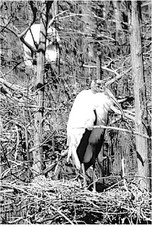
Photo by ETHAN REDDISH A wood stork surveys the nest it has been building among the wooded area near the lake to the right of the Satilla Bridge just over the Pierce-Ware line.





Comments